
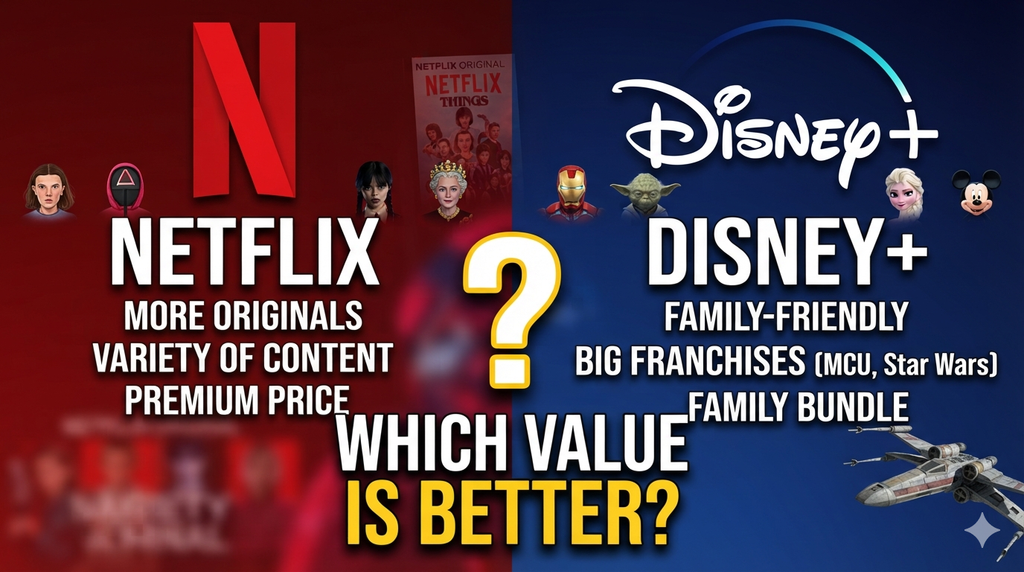
Netflix and Disney+ used to be an easy comparison. Pick the service with the shows you like, compare the monthly price, and subscribe.
That calculation has become more complicated in 2026. Both companies have raised prices, advertising has become a normal part of streaming, and Disney has increasingly combined Disney+ with Hulu. The result is that the cheapest option isn’t necessarily the best value — and the service with the most content isn’t necessarily the one worth paying for.
For a household trying to control entertainment spending, the better question is simple: What will you actually use, and how much will it cost you over a year?
That’s the approach we’ll use here. Rather than declaring one universal winner, we’ll compare the current U.S. pricing, video quality, simultaneous streams, content, advertising, bundles, and the situations in which each service makes the most financial sense.
Current pricing (U.S., as of August 2026)
| Plan | Price | Resolution | Simultaneous streams |
|---|---|---|---|
| Standard with Ads | $8.99/mo | 1080p | 2 |
| Standard | $19.99/mo | 1080p | 2 |
| Premium | $26.99/mo | 4K + HDR | 4 |
Source: Netflix’s March 2026 price increase, reported by CNBC.1
| Plan | List price | Actually available standalone? |
|---|---|---|
| Disney+ Basic (with ads) | $11.99/mo | No — bundled by default |
| Disney+ Premium (no ads) | $18.99/mo ($189.99/yr) | No — bundled by default |
| Disney+, Hulu Bundle (with ads) | $12.99/mo ($11.99 for 6 mo) | Yes — this is the actual entry price |
| Disney+, Hulu Bundle Premium (no ads) | $19.99/mo ($17.99 for 6 mo) | Yes |
Source: Disney’s official pricing page, checked August 2026; standalone-plan discontinuation reported separately.2,3
The first surprise: you’re not really comparing one service with one service
The biggest difference between Netflix and Disney+ right now isn’t resolution or the number of shows. It’s the way the companies package their services.
Netflix is still primarily sold as Netflix. You choose an ad-supported or ad-free plan and then decide whether you need the higher-resolution and additional-stream features of Premium.
Disney’s current signup experience is different. The entry option is centered around the Disney+/Hulu combination.
That changes the value calculation.
If you only want Disney+, you may look at the $12.99 price and think you’re paying more than Netflix’s $8.99 entry plan. That’s true on a simple monthly basis.
But Disney is also giving you access to Hulu content.
If you would otherwise subscribe to Hulu separately, the comparison looks much better for Disney. If you never watch Hulu, however, the bundle isn’t nearly as valuable as it first appears.
This is an important rule for comparing subscriptions:
Never count an included service as a saving unless you would actually use it.
Monthly price versus annual cost
The monthly price is the number most people notice first, but annual spending tells a more useful story.
Netflix Standard with Ads costs $8.99 per month. Keeping it for a full year costs:
$8.99 × 12 = $107.88 per year
Netflix Standard costs $19.99 per month:
$19.99 × 12 = $239.88 per year
Netflix Premium costs $26.99 per month:
$26.99 × 12 = $323.88 per year
That means the difference between Netflix’s cheapest and most expensive plans is $216 per year.
That’s a substantial amount for a single streaming service.
Disney requires a slightly different calculation because the current bundle pricing includes a promotional period. The Disney+/Hulu Bundle is advertised at $11.99 per month for the first six months and then $12.99 per month.
So the first year would be approximately:
($11.99 × 6) + ($12.99 × 6) = $149.88
The promotional price is useful when deciding whether to try the service, but it shouldn’t be treated as the permanent cost.
If you’re budgeting for the next several years, the regular renewal price matters much more than the introductory offer.
Netflix’s cheapest plan is the clear price winner
If the only question is “Which one costs less each month?” Netflix wins.
At $8.99 per month, Netflix Standard with Ads is substantially cheaper than the $12.99 regular price of Disney+/Hulu.
For someone who wants only one streaming subscription and doesn’t particularly care about Disney content, that difference can matter.
The annual difference between Netflix Standard with Ads and the regular Disney+/Hulu Bundle price is:
$12.99 × 12 − $8.99 × 12 = $48 per year
So choosing Netflix instead of Disney+/Hulu could save roughly $48 per year at regular prices.
But $48 is not necessarily enough to make Netflix the better value.
If your family watches Disney and Hulu several times a week, spending an additional $48 a year could be money well spent.
That’s the difference between cheaper and better value.
Netflix Standard: the middle option deserves a closer look
Netflix Standard costs $19.99 per month, or $239.88 per year.
That’s more than twice the price of the $8.99 ad-supported plan.
The major reason to pay the difference is the ad-free experience. If you watch Netflix frequently, eliminating advertising can make the higher price worthwhile.
But if your goal is to save money, this is one of the first places to question your own habits.
Ask yourself how much you actually watch Netflix.
If you watch several hours every week, paying extra for an uninterrupted experience may be reasonable.
If you watch only a few movies a month, spending an additional $132 per year to remove ads may be difficult to justify.
There is no universal answer. The value depends on your tolerance for advertising and how heavily you use the service.
Netflix Premium is expensive — but it has a specific audience
Netflix Premium is $26.99 per month, or $323.88 per year.
At that price, Netflix is no longer a casual entertainment purchase. You’re spending more than $300 per year before taxes on one streaming service.
That doesn’t make Premium a bad deal. It means you should have a reason for buying it.
The main reasons are 4K + HDR and four simultaneous streams.
For a household with a large 4K television and several people watching Netflix at the same time, those features can be useful.
For a single person watching occasionally on a laptop, the additional cost is much harder to justify.
This is a recurring theme in subscription pricing: the highest tier often provides the best specifications, but not necessarily the best value.
4K changes the comparison
Picture quality is one area where consumers should look beyond the headline price.
Netflix reserves 4K + HDR for Premium. That means someone who specifically wants Netflix in 4K has to consider the $26.99 monthly price.
Disney’s plan structure has historically made 4K and HDR available at lower price points on eligible content and devices.
That can make Disney attractive to people who have invested in a 4K television but don’t want to pay Netflix Premium prices.
However, there is an important qualification.
A plan supporting 4K doesn’t mean every title will automatically stream in 4K.
The actual viewing experience depends on the title, device, internet connection and other technical requirements.
So don’t choose a service solely because the word “4K” appears in its plan description. Check whether the content you care about is actually available at the quality you want.
Do you really need four simultaneous streams?
Netflix Premium’s four-stream limit can be useful for families, but it can also be an unnecessary expense.
Consider two households.
The first has one television and one regular Netflix viewer. Four simultaneous streams provide almost no additional value.
The second has parents watching one program while two children are watching different shows on tablets or televisions. In that situation, simultaneous-stream capacity can matter.
Disney’s plans also support multiple simultaneous streams, depending on the current plan terms.
The lesson is simple: pay for capacity when you need it, not because the larger number sounds better.
Netflix has the broader general-entertainment identity
Netflix’s biggest content advantage is breadth.
It isn’t tied to one particular entertainment universe. You can find crime documentaries, international dramas, reality television, comedy specials, anime, documentaries, thrillers and family programming.
That makes Netflix particularly useful for households where different people have very different tastes.
One person might watch a Korean drama. Another might prefer a true-crime documentary. Someone else might want a comedy special.
Netflix’s broad approach can make one subscription useful to several members of the same household.
Disney+ has a different strength.
Disney’s advantage is content you can’t easily substitute
Disney owns a collection of entertainment brands that are unusually difficult for another streaming service to replicate.
Disney animation, Pixar, Marvel and Star Wars are the obvious examples.
If those franchises are important to your household, comparing Disney purely against Netflix’s monthly price misses the point.
You can’t save money by choosing Netflix if the content your family actually wants is on Disney+.
For a family with children, Disney content can also have unusually high repeat value. A movie may be watched many times rather than once.
That makes the practical value of the subscription higher than a simple title count might suggest.
The Hulu factor makes Disney much more competitive
Disney’s inclusion of Hulu changes the calculation for adults and households without children.
Disney+ alone has a strong family and franchise identity. Hulu brings a broader range of general entertainment into the equation.
For someone who watches both Disney and Hulu content, the bundle can therefore cover a wider range of viewing habits than Disney+ alone.
This is where the bundle can become a genuine money-saving tool.
Suppose you were already considering paying for Disney+ and Hulu separately. A combined plan can potentially reduce the cost and simplify billing.
But if you don’t watch Hulu, don’t let the word “bundle” persuade you that you’re automatically saving money.
Ads are increasingly part of the streaming business
Advertising isn’t simply a temporary compromise anymore. It has become an important part of how streaming companies keep entry-level prices lower.
That can actually benefit budget-conscious viewers.
For example, Netflix’s $8.99 ad-supported plan gives you access to the service for less than half the price of its $19.99 Standard plan.
If you’re willing to watch advertisements, you can keep $132 a year in your pocket compared with paying for Netflix Standard.
For a household with several subscriptions, that kind of difference adds up quickly.
The trade-off is your time.
You’re exchanging money for advertising exposure. Some viewers don’t mind. Others consider ad-free viewing worth paying for.
There’s no wrong choice, but it should be a conscious choice.
Subscription fatigue is becoming a bigger issue
Netflix and Disney+ aren’t the only subscriptions competing for your money.
Most households now have several streaming services, and each individual price can seem manageable.
That’s how entertainment spending can creep upward.
A $9 subscription doesn’t feel expensive. Neither does a $13 subscription. Add several more and the total becomes much more noticeable.
Deloitte’s 2026 Digital Media Trends research found that consumers continue to express frustration about rising streaming prices. The research also found that many subscribers are willing to cancel services after price increases.
That tells us something important: consumers are becoming more selective.
And that creates an opportunity to save money.
The smartest strategy may be rotating subscriptions
You don’t necessarily need Netflix and Disney+ every month of the year.
Streaming subscriptions are particularly well suited to rotation.
Suppose your favorite Netflix shows are released during one part of the year, while Disney has several movies or series you want later in the year.
You can subscribe to the service you actually want at the time and cancel when you’ve finished the programs that attracted you.
This approach won’t work for everyone. Some households watch Netflix or Disney+ continuously.
But for occasional viewers, it can save more money than spending hours comparing minor differences between plans.
Saving $13 by canceling a service for one month is still saving money. Doing that across several services can produce meaningful annual savings.
Account sharing is no longer a reliable savings strategy
Older streaming comparisons often assumed that family members and friends could freely share accounts.
That’s no longer a safe assumption.
Netflix has tightened its household-sharing policies and introduced extra-member options in eligible circumstances. Other streaming companies have also become more focused on household-level access.
Before building your budget around sharing an account with someone who lives elsewhere, check the current terms for the specific plan.
A subscription that looks cheap when divided among several households may not remain cheap if additional-member charges apply.
The Money Savvy Lab test: calculate value based on actual use
Here’s a better way to compare streaming services than simply asking which one has the lower price.
Start with three questions:
- What do I actually want to watch?
- How often will I watch it?
- Can this subscription replace another service?
Then consider the features you’re paying for.
If you don’t have a 4K television, 4K capability may not be worth paying extra for.
If only one person watches the service, four simultaneous streams may have little value.
If you don’t mind advertisements, an ad-supported plan may be financially smarter.
If you already pay for Hulu, however, the Disney bundle could potentially eliminate another bill.
This gives us a simple way to think about subscription value:
Real value comes from content you actually use, features you actually need, and subscriptions you can replace.
Everything else is mostly marketing.
Which is better for a single viewer?
For a single viewer, Netflix Standard with Ads is attractive because it keeps the monthly cost low while still providing access to Netflix’s broad catalog.
Disney+/Hulu can make more sense if the viewer specifically wants Disney franchises and also watches Hulu content.
For occasional viewing, consider rotating the services rather than keeping both active.
Which is better for families?
Disney has a strong advantage for families that regularly watch Disney, Pixar, Marvel and Star Wars content.
Netflix can still be valuable for families with older children or adults who want a broader mix of general entertainment.
For many families, the answer may ultimately be both — but that doesn’t mean both need to be active every month.
Which is better for 4K viewers?
This is one of the closest comparisons.
Netflix Premium offers 4K + HDR but costs $26.99 per month.
Disney’s plan structure can provide 4K capabilities at lower price points, making Disney worth considering for households where picture quality is a major factor.
However, check the specific content and device requirements before making a decision based solely on resolution.
Which is better if you hate ads?
If advertisements are a dealbreaker, the calculation changes immediately.
Netflix Standard at $19.99 is substantially more expensive than its $8.99 ad-supported plan.
Disney’s premium bundle is currently $19.99 at the regular price.
At that point, content becomes much more important than the difference between the monthly prices.
If you’re already planning to watch Hulu as well as Disney+, the Disney bundle may offer broader value. If Netflix has most of the shows you care about, Netflix Standard may be the better choice.
When Netflix is the better deal
- You want the lowest monthly price.
- You want one major general-entertainment streaming service.
- You watch many different genres.
- You regularly watch Netflix originals and international programming.
- You don’t need 4K.
- You don’t mind advertisements.
- You don’t need more than two simultaneous streams.
When Disney+/Hulu is the better deal
- Your household regularly watches Disney, Pixar, Marvel or Star Wars.
- You also watch Hulu content.
- You want family entertainment and broader general entertainment in the same subscription.
- 4K/HDR capability is important to you.
- The bundle can replace another subscription you already pay for.
- Several people in your household use the service regularly.
When neither is worth keeping
This is the option most streaming comparisons forget.
Sometimes the best financial decision is to cancel both temporarily.
If you have several streaming subscriptions and aren’t actively watching Netflix or Disney+, keeping them simply because you might watch something later is expensive.
Canceling a $12.99 service for six months saves $77.94.
Canceling a $19.99 service for six months saves $119.94.
Those savings are much more meaningful than arguing over whether one service is $1 or $2 cheaper.
When you have something you genuinely want to watch again, you can subscribe again — assuming the current plan and pricing still work for you.
So which is actually the better value?
It depends on what you’re optimizing for, and being honest about the two isn’t the same question:
- Cheapest way to stream something, don’t care what: Netflix’s $8.99 ad tier is the lowest price point for a single major service.
- Best value for Disney + Hulu viewers: the Disney+/Hulu Bundle can be a strong deal if both libraries are genuinely used.
- Best value for Disney fans: Disney+ wins if Marvel, Star Wars, Pixar and Disney animation are the main reason you’re subscribing.
- Best general-entertainment choice: Netflix is the safer choice if your household watches a wide range of genres.
- Best option for a 4K-focused viewer: compare the actual 4K/HDR features against the price rather than automatically choosing Netflix Premium.
- Best choice for a budget-conscious viewer: start with the cheapest plan that meets your needs and upgrade only when you can identify a feature you actually need.
- Best way to reduce your total streaming bill: rotate subscriptions and cancel services during months when you’re not using them.
Common questions
Can I still get Disney+ by itself?
Disney’s current U.S. signup structure prominently presents Disney+ together with Hulu. Existing customers may have different options depending on their legacy plan, so check your account before changing or canceling a subscription.
Is the $11.99 Disney price permanent?
No. The current $11.99 price for the Disney+/Hulu Bundle is a promotional rate for six months. The regular listed price is $12.99 per month. Always check the renewal price before starting a promotional subscription.
Is Netflix’s $8.99 plan worth it?
For many budget-conscious viewers, yes. It provides a relatively inexpensive way to access Netflix while accepting advertisements. If you watch Netflix regularly and don’t mind ads, it can be much better value than paying $19.99 for the ad-free Standard plan.
Is Netflix Premium worth $26.99?
It can be, particularly for households that have a 4K television and need four simultaneous streams. For occasional viewers or people watching primarily on smaller screens, the extra cost is much harder to justify.
Is Disney+ better for children?
Disney has a particularly strong collection of children’s and family entertainment, including Disney animation and Pixar. If those are frequently watched in your household, Disney can provide substantial practical value.
Is Netflix better for adults?
Netflix generally offers a broader mix of general-entertainment programming, including dramas, documentaries, international series, reality programming and comedy specials. Whether that makes it better depends on the specific programs you watch.
Does the Disney+/Hulu bundle automatically save money?
No. It can save money if you genuinely use both services or if it allows you to cancel another subscription. If you only use Disney+, unused Hulu access shouldn’t be counted as a saving.
Should I keep both Netflix and Disney+?
If your household watches both regularly, keeping both can make sense. If one service is used only occasionally, consider subscribing only during the months when you have content you want to watch.
Which service has more content?
Raw title counts aren’t particularly useful because catalogs change and different databases count titles differently. Instead, make a list of the programs you actually want to watch and compare which service has them.
The bottom line
Netflix is the better deal if your priority is a low-cost, broad general-entertainment service. Its $8.99 ad-supported plan is difficult to beat on price among these two choices.
Disney becomes more compelling when you value its exclusive franchises or actually use Hulu. The Disney+/Hulu bundle changes the comparison because you’re getting access to two different types of entertainment rather than simply another copy of Netflix.
For 4K viewers, the calculation is more complicated. Netflix requires the $26.99 Premium plan for 4K + HDR, while Disney’s plan structure can offer strong video-quality capabilities at lower prices depending on the current plan and content.
For families, Disney’s exclusive content can be extremely valuable. For households with varied adult viewing habits, Netflix’s broader entertainment mix may be more useful.
But if you’re serious about saving money, there’s an even more important conclusion.
You don’t have to choose a permanent winner.
Streaming subscriptions are recurring expenses, and the easiest way to reduce recurring expenses is to stop paying for services you’re not currently using.
Subscribe when there is something you want. Watch it. Then reconsider the subscription.
That approach may save more money over a year than choosing between two plans that differ by only a few dollars per month.
Ultimately, the best streaming service is not the one with the longest list of features. It’s the one that gives your household enough entertainment to justify the money leaving your account every month.
Sources
- CNBC, “Netflix raises prices across all streaming plans,” March 26, 2026.
- Disney+ official pricing page (disneyplus.com/welcome/filter-plans), checked August 2026.
- Reporting on Disney’s standalone Disney+/Hulu plan discontinuation and Hulu-to-Disney+ app integration, 2026.
- American Customer Satisfaction Index, Entertainment Study 2026, published August 18, 2026.
- Deloitte, 2026 Digital Media Trends survey.
- Netflix and Disney+ plan, household and extra-member information based on current service terms.
Pricing, promotional offers, plan availability, advertising policies and streaming features can change. Figures in this article were checked in August 2026. Confirm current pricing and plan details on the official Netflix and Disney+ websites before subscribing or changing an existing plan.
Leave a Reply