
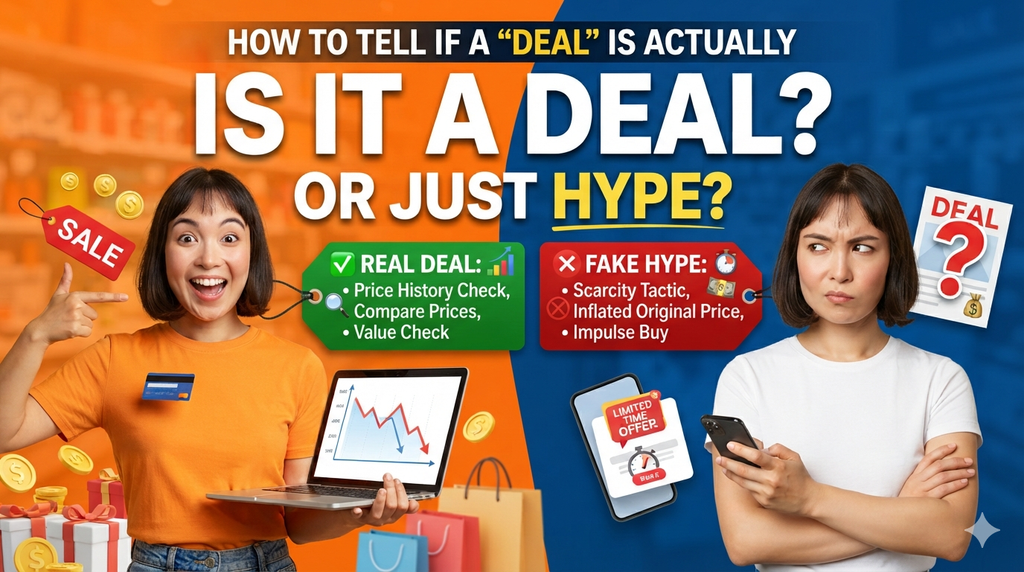
A product marked 50% off can look like a bargain.
But a discount does not automatically mean you are getting a good deal.
The original price may not reflect what the product normally sells for. A coupon may require you to spend more. Free shipping may require a membership. A bundle may give you more products while also making you spend more than you planned.
That is why smart shopping is not really about finding the biggest discount.
It is about figuring out what you are actually paying and what you are getting in return.
This guide shows you how to evaluate a sale before you buy, using a few simple calculations and questions.
What Makes a Deal a Good Deal?
A good deal has three basic characteristics:
- The price is genuinely competitive.
- The product provides enough value for the price.
- You would want the product even without the promotion.
That third point is easy to overlook.
If you spend $80 on something you did not need simply because it was 40% off, you did not save $32.
You spent $80.
A discount is useful when it reduces the cost of a purchase you already consider worthwhile.
1. Don’t Start With the Discount Percentage
One of the easiest ways to make a product look attractive is to display a large discount.
For example:
Regular price: $200
Sale price: $120
Save 40%
The advertisement makes the $80 savings look like the most important number.
It isn’t.
The first question should be:
“Is $120 actually a good price for this product?”
If similar products normally sell for $125–$135, then $120 could be a reasonable deal.
But if the same product regularly sells for $115, the 40% discount is not nearly as impressive.
The advertised original price is useful information, but it should not be the only benchmark you use.
A better comparison
| Product | Advertised Price | Typical Price | What You Actually Save |
|---|---|---|---|
| A | $120 | $125 | $5 |
| B | $120 | $150 | $30 |
| C | $120 | $180 | $60 |
All three products could be advertised as “40% off.”
Yet the real savings are very different.
Start with the price you will pay, then compare it with the product’s typical market price.
2. Find the Typical Price
Before making a significant purchase, spend a few minutes checking what the product normally costs.
This is particularly useful for:
- Electronics
- Appliances
- Furniture
- Tools
- Computer equipment
- Larger household purchases
- Seasonal products
Search for the exact product model and compare several retailers.
For electronics, don’t compare only the product name. Check the model number and specifications.
A television with the same screen size may have a different panel, processor, refresh rate, storage capacity, or feature set.
The same principle applies to appliances and other products.
A lower price is not necessarily a lower price for the same thing.
3. Calculate the True Final Price
The price displayed on the product page may not be your real cost.
For an online purchase, think about:
Product price + shipping + fees + required membership − discounts
For example:
- Sale price: $75
- Shipping: $8
- Required membership: $5
- Coupon: −$10
Your effective cost is:
$78
That is the number you should compare with other retailers.
This is especially important when a promotion advertises free shipping only after you reach a minimum purchase amount.
If you add $25 of products you did not need just to avoid an $8 shipping charge, you have not necessarily saved money.
4. Use Unit Price When Quantities Differ
Unit price is one of the most useful tools for evaluating everyday deals.
Imagine two packages of detergent:
Option A: $12 for 100 loads
Option B: $15 for 150 loads
Option A costs less at checkout.
But the unit cost is:
Option A: $12 ÷ 100 = $0.12 per load
Option B: $15 ÷ 150 = $0.10 per load
Option B costs more today but less per load.
The same method works for:
- Toilet paper
- Paper towels
- Laundry detergent
- Shampoo
- Pet food
- Coffee
- Cleaning products
- Food sold in different package sizes
Don’t assume the larger package is cheaper.
Calculate the cost per ounce, pound, item, serving, load, or other useful unit.
5. Be Careful With “Buy More, Save More”
Quantity discounts can be useful when you were already planning to buy more.
They can also increase your spending.
Suppose a retailer offers:
1 item: $30
2 items: $54
3 items: $72
The third item appears to be a bargain.
But if you only needed one, the relevant comparison is not:
“How much cheaper is the third item?”
It is:
“Do I want to spend another $42 to get two more?”
A bulk promotion makes sense when the additional products are things you will actually use.
It is less attractive when:
- The product expires
- You have limited storage
- You are uncertain whether you like it
- The promotion encourages an unplanned purchase
- You would not have bought the extra items otherwise
A lower unit price does not automatically mean lower total spending.
6. Don’t Let a Coupon Change Your Shopping Plan
Coupons can save money—but only if you use them strategically.
Consider this offer:
$20 off orders of $100 or more
Your cart currently contains $82 of products.
You could add an $18 item to reach $100.
After the coupon, your total would be:
$100 − $20 = $80
So technically, you spent $2 less than your original $82 cart.
But you also bought something you may not have wanted.
The important question is not:
“How much is the coupon worth?”
Instead ask:
“Would I have bought these items without the coupon?”
If the answer is no, the promotion may be encouraging unnecessary spending.
7. “Free” Does Not Always Mean Free
Retail promotions often use the word free because it is attention-grabbing.
But look at the conditions.
Examples include:
- Free shipping with a minimum purchase
- Free gift with purchase
- Free trial that becomes a paid subscription
- Free second item when another item is purchased
- Free membership for a limited period
Before accepting the offer, ask:
“What do I have to spend or agree to in order to get this?”
A free item is valuable only if the purchase required to obtain it still makes sense.
8. Compare Comparable Products
A deal should not be evaluated in isolation.
Suppose a $250 coffee machine is discounted to $180.
That sounds good.
But imagine three comparable machines:
| Product | Price | Key Consideration |
|---|---|---|
| A | $180 | Current sale |
| B | $165 | Similar features |
| C | $210 | Longer warranty |
The $180 product might still be the right choice.
But now you have context.
The question is no longer:
“Did I save $70?”
It becomes:
“Does this product offer enough value at $180 compared with the alternatives?”
Sometimes the cheapest option is the best value.
Sometimes paying more makes sense because you are getting better durability, support, performance, or warranty coverage.
9. Consider Cost Per Use
For products you expect to use frequently, purchase price alone can be misleading.
Imagine two backpacks:
Backpack A: $50, expected to last 2 years
Backpack B: $90, expected to last 5 years
The $50 backpack is cheaper today.
But if you use the product regularly, the more expensive option may provide better long-term value.
A simple calculation is:
Cost per year = Purchase price ÷ Expected years of use
For Backpack A:
$50 ÷ 2 = $25 per year
For Backpack B:
$90 ÷ 5 = $18 per year
This is not a guarantee that Backpack B is better. Expected lifespan can be difficult to predict.
But it illustrates an important point:
The lowest purchase price is not always the lowest long-term cost.
10. Check for Additional Costs
Some purchases have costs that are easy to overlook.
Before calling something a deal, consider whether you will also pay for:
- Replacement parts
- Accessories
- Batteries
- Filters
- Maintenance
- Required subscriptions
- Special software
- Installation
- Delivery
- Extended warranties
For example, a device may be $30 cheaper than a competing product but require a paid subscription for features you consider important.
The cheaper purchase price may not tell the whole story.
For products you plan to keep for several years, ownership cost can be more useful than purchase price.
11. Watch the Return Policy
A cheap product becomes less attractive if returning it is difficult or expensive.
Before buying, especially online, check:
- Return period
- Return shipping
- Restocking fees
- Final-sale restrictions
- Warranty
- Exchange policy
This matters particularly for:
- Clothing
- Shoes
- Furniture
- Electronics
- Large appliances
Suppose Store A sells an item for $90 with free returns.
Store B sells it for $80 but charges $20 to return it.
If you are unsure about the purchase, the $90 option may actually carry less financial risk.
The cheapest sticker price is not always the cheapest decision.
12. Don’t Let a Countdown Timer Make the Decision
“Only 3 hours left.”
“Last chance.”
“Sale ends tonight.”
These messages are designed to create urgency.
Sometimes the deadline is genuine.
But you should not let a countdown prevent you from doing basic price research.
For an inexpensive planned purchase, a quick comparison may be enough.
For an expensive purchase, take a little more time.
Ask:
- What is the final price?
- What does this normally cost?
- What are comparable products selling for?
- Do I need it now?
- What happens if I wait?
A real bargain should still make sense after a few minutes of thinking.
Deal Red Flags to Watch For
Not every promotion is misleading, but certain patterns deserve extra attention.
🚩 A huge discount from an unusually high “original” price
The sale price may be reasonable even if the advertised savings are exaggerated.
🚩 A minimum purchase requirement
You may spend more than planned to unlock a discount.
🚩 A bundle containing products you don’t need
A lower bundle price does not make unwanted products valuable.
🚩 A subscription attached to the promotion
Check whether a free or discounted period automatically becomes a paid plan.
🚩 Shipping that eliminates the savings
Always calculate the final checkout price.
🚩 A “limited-time” promotion that you feel pressured to accept
Urgency can interfere with comparison shopping.
🚩 A product with an unusually low price but different specifications
Make sure you are comparing the same model or version.
These are not proof that a promotion is bad.
They are simply reasons to look more closely.
A Simple “Real Deal” Formula
When you want a quick way to evaluate an offer, use this formula:
Real Savings = Typical Market Price − True Final Cost
For example:
Typical market price: $150
Your true final cost: $115
Estimated real savings:
$150 − $115 = $35
Now add another important calculation:
Cost Per Use = True Final Cost ÷ Expected Number of Uses
If you expect to use the product 100 times:
$115 ÷ 100 = $1.15 per use
These calculations will not tell you whether you should buy the product.
They simply give you better information for making the decision.
The 5-Minute Deal Check
You can evaluate most ordinary shopping deals with six questions.
1. What is my actual final price?
Include shipping, fees, subscriptions, and discounts.
2. What does this product normally sell for?
Don’t rely exclusively on the advertised original price.
3. What are comparable products selling for?
Look at similar products with similar specifications.
4. Do I actually need it?
A discount does not create a need.
5. How often will I use it?
Frequent use can make a higher-quality purchase more worthwhile.
6. Would I buy it without the promotion?
If the answer is no, stop and reconsider.
If the answer to all six questions looks good, you are much more likely to be looking at a genuinely worthwhile deal.
Example: Is a $129 Sale Really a Good Deal?
Imagine you find a kitchen appliance advertised at:
Regular price: $199
Sale price: $129
The advertisement says you are saving $70.
Before purchasing, you check three things.
Step 1: Compare the market price
Other retailers sell the same model for:
- $135
- $139
- $145
So $129 is genuinely competitive.
Step 2: Calculate the final cost
Shipping is $10, but you have a $10 coupon.
Your final cost remains:
$129
Step 3: Consider alternatives
A similar model costs $115 but has fewer features.
Another costs $150 and includes a longer warranty.
Now the $129 product looks reasonable.
Step 4: Ask whether you need it
You have been planning to replace your old appliance because it is no longer working reliably.
That makes the purchase different from buying something simply because it is on sale.
Conclusion
The $70 advertised savings are not the main reason this appears to be a good deal.
The stronger evidence is that:
- $129 is below the current comparable prices
- The final price is clear
- The product meets your needs
- Comparable alternatives were considered
- You were already planning to make the purchase
That’s what a good deal looks like.
The Best Deal May Be the One You Don’t Buy
There is one final test that is easy to forget.
Sometimes the best deal is not buying anything.
If you already have a product that works well, replacing it because a newer version is discounted may not save you money.
A $300 product discounted to $200 is still a $200 purchase.
If you do not need it, the savings are effectively:
$0 spent = $0
This is especially important during major shopping periods when sales are everywhere.
Instead of browsing first and deciding what to buy, try the opposite approach:
Decide what you need first. Then look for the best price.
That small change can prevent a lot of unnecessary spending.
Final Takeaway
A genuine deal is more than a large discount.
Before buying, look beyond the sale label and check:
True final price → Typical price → Comparable products → Long-term value → Additional costs → Actual need
The biggest percentage discount is not necessarily the best bargain.
The lowest price is not necessarily the best value.
And buying something you do not need is not really saving money—even when the price is 50% off.
The smartest shoppers don’t ask only:
“How much am I saving?”
They ask:
“Is this worth what I’m paying?”
That is the question that turns a sale into a real deal.
Leave a Reply