
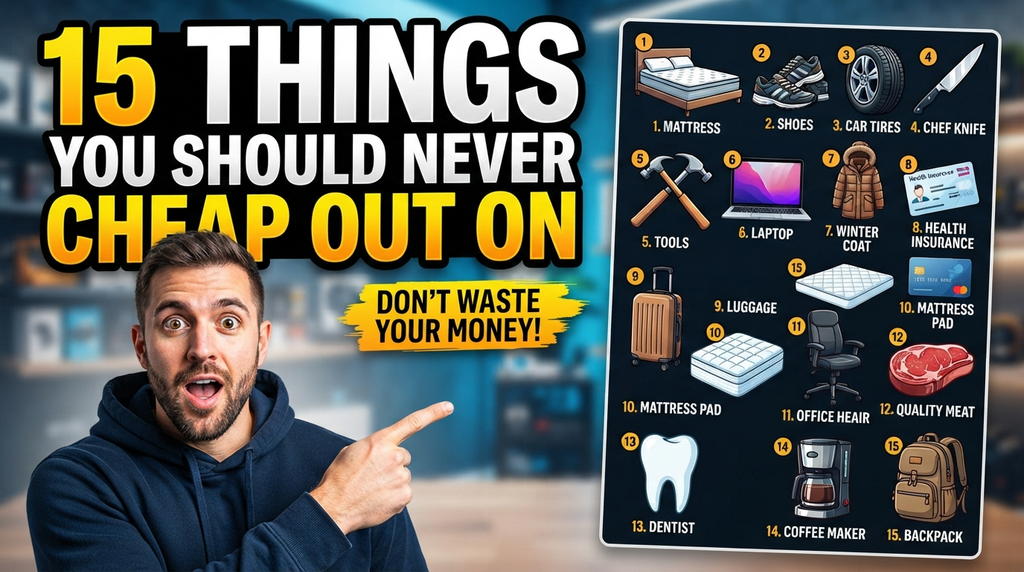
Being frugal doesn’t mean buying the cheapest version of everything. Sometimes, the lowest price is the beginning of a much more expensive purchase.
A $30 product that needs to be replaced every year can cost more over time than an $80 product that lasts four years. And when safety, comfort, or reliability is involved, the cheapest option can create problems that go far beyond the original price tag.
But here’s the other side of the argument: expensive doesn’t automatically mean better. Paying extra for a recognizable brand, unnecessary features, or premium packaging isn’t necessarily smart spending.
The real goal is to identify where quality makes a measurable difference and where you can safely keep more money in your pocket.
If you’ve already read our guide to 20 Things Worth Spending More Money On (And When to Save), this article takes that idea a step further. We’ll look at 15 specific purchases, explain why the cheapest option can backfire, and identify when paying more is actually worth it.
1. Tires
Tires are one of the worst places to make a purchasing decision based on price alone.
They’re your vehicle’s only contact with the road, so tread life, wet-weather traction, braking performance, and suitability for your driving conditions matter.
An inexpensive tire isn’t automatically unsafe, and an expensive tire isn’t automatically the best choice. The important distinction is whether the tire meets appropriate safety standards and performs well for your vehicle and typical driving conditions.
Before buying, compare independent tire tests, expected tread life, warranty coverage, and the total installed price. Remember that installation, balancing, and other fees can make a seemingly inexpensive option less attractive.
Money Savvy Lab verdict: Buy reputable tires suited to your vehicle and driving needs. Skip unnecessary performance upgrades, but don’t choose a tire based on the lowest advertised price alone.
2. Mattresses
A mattress is one of the most frequently used products in your home. You may spend around a third of your life sleeping, which makes comfort and durability worth considering.
However, the most expensive mattress isn’t necessarily the best investment.
A $2,000 mattress doesn’t automatically provide twice the comfort or twice the lifespan of a $1,000 mattress. Your sleeping position, preferred firmness, support, construction, and the mattress’s actual durability matter much more than the brand’s marketing.
Consider this hypothetical comparison:
| Mattress | Purchase price | Useful life | Cost per year |
|---|---|---|---|
| Budget mattress | $400 | 3 years | $133 |
| Mid-range mattress | $800 | 8 years | $100 |
| Premium mattress | $1,800 | 8 years | $225 |
These figures illustrate the calculation rather than guarantee a mattress’s lifespan. The lesson is that a mid-range mattress can offer better long-term value than either extreme.
Before shopping, compare warranty exclusions, trial periods, return fees, and the support you actually need.
Money Savvy Lab verdict: Spend enough to get a comfortable, supportive mattress that suits you. Don’t confuse a luxury price tag with a better night’s sleep.
3. Everyday Shoes
The cheapest shoes can become expensive when you wear them constantly.
If you walk frequently, stand for hours, or commute on foot, comfort and construction matter. Shoes that wear out quickly may need repeated replacement, while poorly fitting footwear can make everyday activities less comfortable.
Let’s compare two hypothetical purchases:
| Budget shoes | Better-quality shoes | |
|---|---|---|
| Purchase price | $30 | $75 |
| Estimated wears | 50 | 200 |
| Cost per wear | $0.60 | $0.38 |
In this example, the more expensive pair costs less per wear. But that result depends entirely on how long each pair actually lasts.
You don’t need premium shoes for every occasion. Inexpensive shoes may be perfectly reasonable for occasional events or styles you won’t wear often.
Money Savvy Lab verdict: Prioritize fit, comfort, and durability for everyday footwear. Buy less expensive shoes when usage is limited or the item is primarily a short-term fashion choice.
4. Smoke and Carbon Monoxide Detectors
This is one purchase where saving a few dollars should not be your main objective.
Smoke and carbon monoxide detectors provide warnings about hazards that may not otherwise be apparent. Reliability, appropriate certification, correct placement, and proper maintenance matter far more than getting the lowest price.
When comparing products, check recognized safety certifications, compatibility with your home’s setup, alarm features, and manufacturer instructions.
Buying a quality detector isn’t enough, either. It needs to be installed correctly, tested regularly, and replaced according to its manufacturer’s instructions.
Money Savvy Lab verdict: Choose properly certified, reliable safety equipment. Don’t sacrifice essential safety features to save a small amount.
5. Extension Cords and Power Strips
Extension cords and power strips may look like interchangeable household accessories, but their electrical ratings and intended uses matter.
A product suitable for a lamp may not be appropriate for a high-powered appliance. Overloading a power strip or using an unsuitable extension cord can create a fire hazard.
Look for appropriate ratings, reputable manufacturers, recognized safety certification, and clear instructions. Avoid damaged cords, counterfeit products, and products that don’t clearly identify their electrical specifications.
You don’t necessarily need an expensive model with every available feature. You do need one that is suitable for the intended load.
Money Savvy Lab verdict: Save on unnecessary extras, not on appropriate electrical ratings or safety.
6. Kitchen Knives
You don’t need a $300 chef’s knife to prepare dinner well. But buying the cheapest knife available isn’t always a bargain, either.
A decent knife can make food preparation easier, feel more comfortable in your hand, and remain useful with proper cleaning, sharpening, and maintenance.
The mistake is buying a large knife set when you only need a few useful pieces.
For many home cooks, a quality chef’s knife, a paring knife, and a serrated bread knife are more practical than a drawer full of inexpensive knives.
If you’re updating your kitchen, our guide to Best Budget-Friendly Kitchen Appliances That Are Actually Worth Buying offers another perspective on balancing affordability with everyday usefulness.
Money Savvy Lab verdict: Invest in the kitchen tools you use most. You don’t need premium versions of everything in your kitchen.
7. Luggage
Luggage takes a beating. It gets dragged across sidewalks, loaded into car trunks, rolled through airports, and handled repeatedly during travel.
Wheels, handles, zippers, seams, and overall construction determine whether a suitcase remains useful or becomes an inconvenience halfway through a trip.
But your travel habits should determine how much you spend.
Someone who travels every month may benefit from durable luggage with replaceable components and a good warranty. Someone who takes one weekend trip every few years may be perfectly happy with a basic suitcase.
Before buying, check warranty exclusions, wheel construction, weight, dimensions, and whether replacement parts are available.
Money Savvy Lab verdict: Frequent travelers should prioritize durability and repairability. Occasional travelers can save without automatically sacrificing value.
8. Office Chairs
If you sit at a desk for several hours a day, your chair deserves more attention than decorative office accessories.
A poorly fitting chair can become uncomfortable, and a chair with limited adjustability may not suit your body or workstation. Meanwhile, a premium chair isn’t automatically right for everyone.
Look for adjustable seat height, suitable seat depth, appropriate back support, and construction that matches your expected use.
If you work from home, think about how many hours you spend sitting each week. A modest improvement in comfort can be meaningful when repeated day after day.
Money Savvy Lab verdict: Spend more when you need better adjustability and durability for regular use. Skip expensive executive styling if it doesn’t improve function.
9. Winter Coats and Weather Gear
A coat that looks warm in a product photo may perform poorly in freezing rain or strong winds.
When temperatures drop, insulation, wind resistance, water resistance, construction, and fit matter. The right combination depends on your climate and how much time you spend outdoors.
However, you don’t need expedition-grade clothing for a mild winter. Paying for advanced technical features you rarely use is another form of waste.
Look for products designed for your actual conditions, and compare practical features rather than relying on brand prestige.
Money Savvy Lab verdict: Match the product to the weather you face. Pay for useful performance, not features that will sit unused in your closet.
10. Bedding and Sheets
Sheets, pillowcases, and other bedding are washed repeatedly, so construction and material quality can affect how long they remain comfortable.
That doesn’t mean luxury bedding is a necessity.
A reasonably priced set made from a material you enjoy may provide excellent value. Expensive marketing claims and high thread counts alone don’t guarantee better quality.
Consider fabric feel, care instructions, construction, and whether the product suits your sleeping preferences.
Money Savvy Lab verdict: Choose comfortable, durable bedding at a price that makes sense for your household. Upgrade when you notice a meaningful improvement, not just because a product is labeled premium.
11. Power Tools You Use Frequently
An inexpensive drill may be all you need for hanging pictures or assembling furniture a few times a year.
But regular DIY projects create a different calculation. Battery performance, ergonomics, durability, repair options, and compatibility with other tools become more important as usage increases.
A particularly important consideration is the battery ecosystem. Buying several tools that require different batteries and chargers can cost more than choosing a compatible system from the beginning.
Before upgrading, consider how frequently you’ll use the tool, whether you can borrow or rent it, and whether the additional performance will actually save you time.
Money Savvy Lab verdict: Buy basic tools for occasional jobs. Invest in better equipment when frequent use justifies the added cost.
12. Bras and Everyday Undergarments
Everyday basics go through repeated wear and washing. Fit, construction, comfort, and durability matter more than a recognizable label.
An inexpensive item can be a good deal if it fits well and lasts. A more expensive one may be worthwhile if it offers a better fit or survives repeated use substantially longer.
The key is not to equate price with quality automatically.
Look for comfortable materials, suitable construction, and care instructions you can realistically follow.
Money Savvy Lab verdict: Spend according to fit and durability. You don’t need designer basics, but you shouldn’t keep replacing uncomfortable items simply because they were cheap.
13. Cookware You Use Every Day
You don’t need to replace your entire kitchen with premium cookware.
Instead, identify the pieces you use most frequently. A reliable skillet or saucepan may deliver more value than a complete set containing several pieces you rarely touch.
For cookware, compare construction, heat distribution, compatibility with your cooktop, cleaning requirements, and expected maintenance.
Also factor in how you cook. Someone who prepares meals daily may benefit from more durable cookware, while someone who cooks occasionally may have little reason to upgrade.
If you’re looking for ways to save on household equipment without buying poor-quality products, see 10 Home Products That Can Save You Money in the Long Run.
Money Savvy Lab verdict: Upgrade selectively. Spend on the cookware that earns its place in your daily routine and save on specialty items you rarely use.
14. Home Security Hardware
Locks, door hardware, and other security-related products deserve more consideration than their appearance or price alone might suggest.
Look for reputable construction, suitable security ratings where applicable, compatibility with your doors, and installation instructions.
At the same time, an expensive smart lock isn’t automatically a better security choice than a simpler, well-made lock. Added technology may offer convenience, but it also introduces batteries, connectivity, and additional features to maintain.
Choose products based on the actual security requirements of your home.
Money Savvy Lab verdict: Prioritize appropriate security performance and reliable construction. Don’t pay extra for technology you won’t use, and don’t choose solely by the lowest price.
15. Critical Replacement Parts
Replacement filters, chargers, batteries, appliance parts, and other components are tempting places to cut costs.
Sometimes generic products provide excellent value. In other cases, poor compatibility or quality can create problems that outweigh the savings.
The right decision depends on the component and the consequences of failure.
For a low-risk accessory, a compatible third-party product may be perfectly reasonable. For a safety-critical component or a part that could damage expensive equipment, careful verification matters much more.
Before buying, compare specifications, compatibility, warranty coverage, credible reviews, and the cost of a potential failure.
Money Savvy Lab verdict: Don’t automatically buy original manufacturer parts, but don’t assume the cheapest compatible-looking option is equivalent, either.
The Three-Question Test: Should You Spend More?
Before paying extra for a product, ask three questions.
1. How Often Will You Use It?
Daily-use items have more opportunities to deliver value from better comfort, durability, and performance.
An $80 item used 400 times may offer better value than a $25 item used 30 times. But the calculation only works if the more expensive item actually lasts and performs better.
2. What Happens If It Fails?
A broken decorative accessory is an inconvenience. A failed safety device, unsuitable electrical product, or broken suitcase during an important trip can have much greater consequences.
The more serious the potential consequences, the less sense it makes to prioritize price alone.
3. How Difficult or Expensive Is It to Replace?
Consider not only the replacement price but also installation, maintenance, downtime, and inconvenience.
A product that costs slightly more but avoids frequent replacements may be the better financial choice.
For another practical framework, read How to Tell If a “Deal” Is Actually a Good Deal. A discount is only valuable when the underlying purchase makes sense.
When You Should NOT Spend More
The opposite mistake is assuming that expensive products are always worth the money.
There are plenty of categories where buying inexpensive is a perfectly rational decision.
| Purchase | Why Spending Less May Make Sense |
|---|---|
| Decorative home accessories | Higher prices may primarily reflect design or branding |
| Seasonal decorations | Many are used only a few weeks each year |
| Basic storage containers | Simple products often perform the same essential function |
| Occasional-use kitchen gadgets | Premium construction may offer little practical return |
| Trendy clothing | A short period of use can make a premium purchase difficult to justify |
| Simple organizers | Additional features may not improve everyday usefulness |
| Specialty tools used once | Borrowing or renting may be cheaper than buying premium equipment |
The important distinction is whether the additional spending buys something you’ll genuinely use.
If you’re tempted by a sale, consider reading 15 Things You Should Stop Buying at Full Price. Sometimes the smartest way to buy a quality product is simply to wait for the right price.
And if you’re considering secondhand purchases, our guide to 12 Things That Are Actually Worth Buying Used can help you identify categories where buying pre-owned makes financial sense.
The Hidden Cost of Buying Cheap
The purchase price is only one part of the equation.
A more useful way to compare products is:
Total ownership cost = purchase price + maintenance + replacement costs + other expenses caused by failure.
Consider two hypothetical products:
| Product A | Product B | |
|---|---|---|
| Initial price | $30 | $80 |
| Replacement interval | 1 year | 4 years |
| Cost over 4 years | $120 | $80 |
| Average annual cost | $30 | $20 |
These figures assume the products perform as expected and exclude maintenance and other expenses. They’re examples, not predictions about any particular product.
The point is simple: the product with the lower purchase price isn’t necessarily the one that costs less to own.
This is also why avoiding unnecessary purchases matters. If you buy something simply because it looks like a bargain, even a low price can represent wasted money.
Our article on How to Stop Wasting Money on Everyday Purchases: 12 Simple Ways to Spend Less explores the broader habits that can help you keep more of what you earn.
A Smarter Way to Spend: Buy Quality Selectively
You don’t need to buy premium products across every category. Instead, divide your spending into three groups.
| Purchase Type | Smart Strategy |
|---|---|
| Frequently used items | Prioritize durability, comfort, and cost per use |
| Safety-critical products | Prioritize appropriate standards and reliability |
| Rarely used items | Consider inexpensive, borrowed, or rented options |
| Easy-to-replace products | Avoid paying for unnecessary durability |
| Expensive-to-replace products | Compare long-term ownership costs |
| Status-driven purchases | Question whether the premium provides real value |
This approach also applies to household expenses beyond shopping.
For example, buying an energy-efficient appliance can sometimes reduce operating costs over its lifetime. But the purchase only makes financial sense when the expected savings justify the price difference.
You can explore that calculation in Best Energy-Efficient Appliances That Can Lower Your Utility Bills.
Similarly, reducing recurring household expenses can free up money for purchases where quality matters more. See How to Lower Your Monthly Bills Without Giving Up the Things You Need for more ways to find savings without cutting everything you enjoy.
Final Verdict: Don’t Pay Twice for the Same Thing
Being frugal doesn’t mean winning the lowest-price contest.
Sometimes the cheapest option is exactly what you should buy. Other times, it’s simply the first payment on a more expensive purchase.
Spend more when durability, safety, comfort, or reliability creates a meaningful benefit. Save when the product is easy to replace, rarely used, or when the premium price mostly buys branding rather than performance.
And before paying full price for something you genuinely need, check whether waiting for a better offer could save you money without compromising quality.
The goal isn’t to own the most expensive products.
It’s to spend your money where it produces the most value—and avoid paying twice for things that should have lasted in the first place.
Frequently Asked Questions
Is It Always Better to Buy Expensive Products?
No. Price alone doesn’t determine quality. A mid-range product can provide the best balance of durability, performance, and cost. Pay more when the improvement matters to you, not simply because a product is expensive.
What Things Should You Never Buy Cheap?
Safety-related products, frequently used items, and products that are costly or inconvenient to replace deserve careful consideration. Tires, smoke detectors, suitable electrical equipment, and everyday footwear are examples where price should not be the only factor.
How Do I Know When Spending More Is Worth It?
Consider frequency of use, the consequences of failure, expected lifespan, and replacement costs. If a more expensive option delivers meaningful improvements in these areas, it may provide better long-term value.
Is Buying Cheap Actually More Expensive?
Sometimes. A product that needs frequent replacement can cost more over time than a durable alternative. Compare cost per year or cost per use rather than relying exclusively on the initial price.
Should I Always Buy the Most Expensive Option?
No. Premium products often offer diminishing returns. The best value is frequently a mid-range option that provides the features and quality you need without unnecessary extras.
What Is the Biggest Mistake People Make When Trying to Save Money?
Focusing exclusively on the purchase price. A smarter approach considers total ownership costs, actual usage, durability, maintenance, and whether the product delivers meaningful value.
Is It Worth Buying Quality Products on Sale?
It can be, provided the product meets your needs and the discount is genuine. Compare the actual price with competing products and consider the total cost of ownership rather than treating every markdown as a good deal.
Leave a Reply